Next Exhibit Reception for “Appalachian Beautiful” to Take Place on September 26th at 4pm, Pikeville Center for the Arts!
Most of you that have followed my work, some since I picked up a camera at age 17, associate most everything I do with photojournalism and documentary portraiture. Is “Appalachian Beautiful” what you expect of me? For many probably not. For those that have known me the longest, probably so.
Is it Appalachian? Probably more so than most realize!
Is it honest? Yes and no. It isn’t honest like the Appalachian photographs you might associate me with that I have been posting on social media for at least 15 years or more. And you might have noticed I haven’t been posting expectations as of late. If you want to see those expectations, best subscribe to either The Mountain Eagle or the Tri-City News (although I haven’t been getting to the Tri-Cities as much as I would like as of late because of the weather).
I have much less road in front of me than behind me. I began my career working for small town newspapers including The Tri-City News among others. I also worked for a period of time at the beginning of my career for Tom and Pat Gish. Working for those small-town papers is how I also want to travel the road left in front of me.
As for this project, “Appalachian Beautiful,” I have always been enamored by the strength and resilience of Appalachian women. I had two tough but loving grannies, Lula Ritchie Vanover and Mattie Ison Wilson, the strongest woman I’ve ever known, my mother, Jean Cloise Vanover Wilson. who fought breast cancer for nearly twenty years, a freaking amazing sister who is turning the way we deal with the children in Appalachia upside down, Kateena Wilson Haynes, and two brilliant, big-hearted daughters, Malandra Jalyne Hueglin and Jessica Molley Blindt Carpenter to name a few!
The concept of “Appalachian Beautiful” began after watching some online interviews by social media influencers, or better yet, social media sensationalists that tried to paint Appalachian women with a very broad, stereotypical brush. What they are trying to peddle is anything but the truth! These weren’t the Appalachian women that raised me, that I grew up with or I lived around.
When I lived in Cincinnati, I had the privilege to see an exhibition of George Hurrell photographs at the Cincinnati Art Museum. George, raised in Cincinnati and spending a short amount of time in Northern Kentucky, moved to Hollywood in the 1920s and became the most celebrated photographer to Hollywood stars and starlets. His work was breathtaking to say the least. That stuck like glue.
After being uninfluenced by those social media influencers, this project was conceived. The first thing I did was watch an hour-long documentary about George and his work. Then I ordered a very thick book about George and his work that includes a multitude of his photographs.
All his photographs were retouched using something called an Adams Retouching Machine. I thought, could I do the same, using modern technology while staying within the parameters of what George could do?
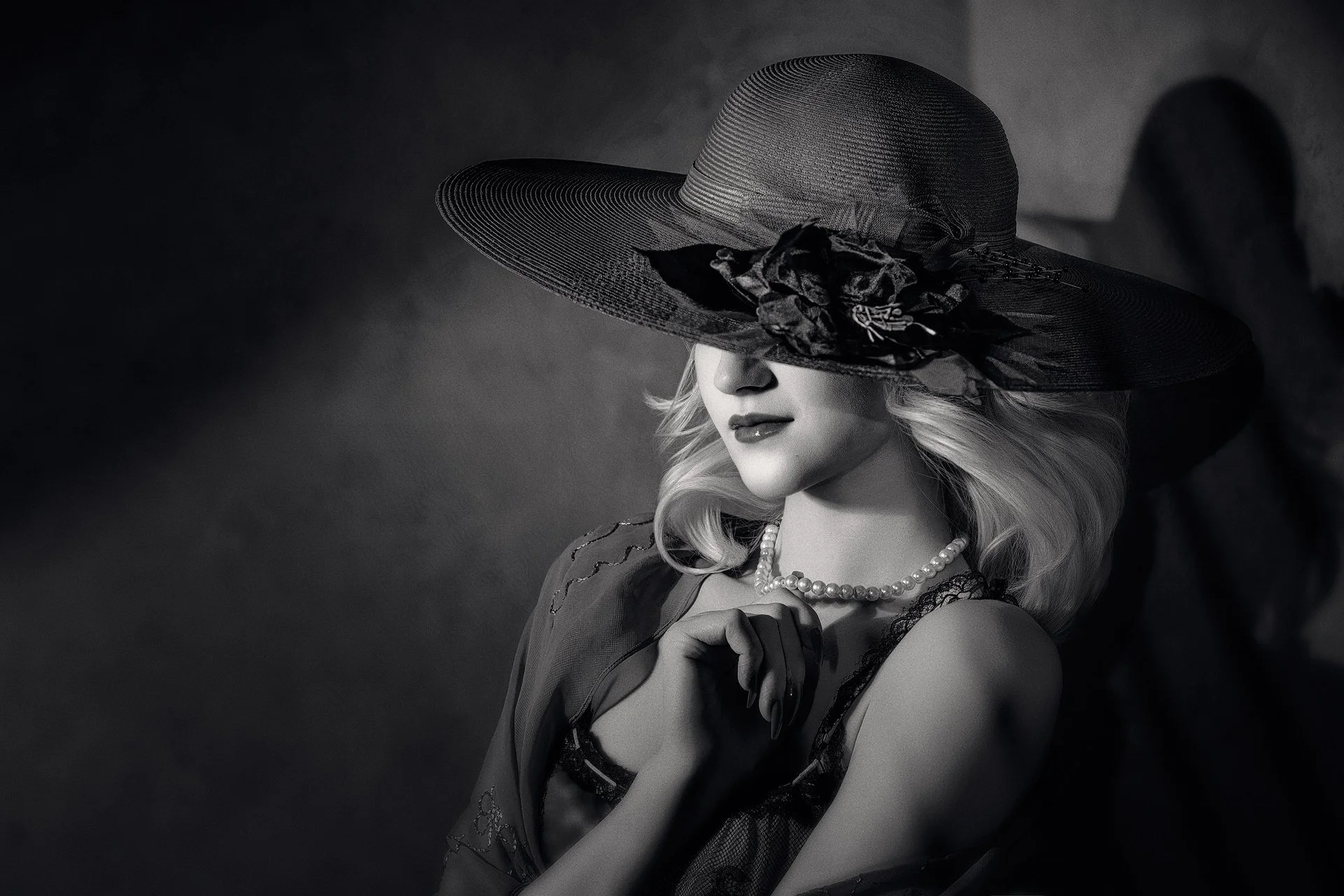
I also started thinking about the idea of what George’s photographs of Appalachian women would be if they went back in time and were starlets. That would make for an amazing counter narrative to the social media “un-influencers.”
After some discussion with my intern at the time, Deladis Haywood, this project was logistically launched.
It has been two years since I first began testing for this endeavor. During that time 35 women from literally all walks of Appalachian life have given up their precious time to trust me and sit in front of my camera. As they did, I made social media posts of them as George Hurrell would have possibly seen them, getting permission from each one.
As the work became more public, more women asked to take part. Each was required to fill out an online form, sign a release and describe why they wanted to participate. I was blown away by every one of their responses, but one hit harder than any as of recent. With her permission and completely unedited is the response by Arletta Adams:
"For generations, Appalachian women have been stripped down to stereotypes—painted as dirty, uneducated, and disposable. These labels didn’t just misrepresent us; they taught us to be ashamed of our own reflection, our voices, and our roots.
I know this shame personally. As a recovering addict rebuilding my life, I left the mountains behind and took my heritage with me—or so I thought. I lied about where I was from. I trained myself to soften my accent, to sound less Appalachian, because I believed sounding like home made me something less. That truth still breaks my heart. I allowed the world’s ignorance to rewrite who I was. No woman should ever have to erase herself to be accepted.
We are not the stereotypes. We are resilient, brilliant, beautiful, and unbreakable Appalachian women. Our stories are rich. Our strength is inherited. Our voices matter. This project is our chance to reclaim what was taken from us—to stand proud, speak loudly, and force the world to see us for who we truly are. Taking part in this would mean everything to me—not just for myself, but for every Appalachian woman who was ever taught to feel small."
Arletta Adams
I consider myself both an artist and a photographer, and you can be both, together and independently. For years my artist statement for everything I do is simple:
“My work isn’t for scholars, critics or pundits. It is work of the people, by the people and for the people.” My response from “the people”, mostly women but some wonderful men as well, has been heartfelt. More women want to take part. And Arletta doesn’t stand alone in her words. So many others have touched me deeply as well.
As for the majority of men, the work either frightens them, or they try to hide behind male bravado. These are usually men I see when I’m out and about. They seldom remark on a public forum. Those that do remark publicly are mostly gentlemanly in their responses.
I know more than ever now that this project is worthy and going down the right path. Although I have two other projects in the wings, this one will continue longer than I originally expected.
To again quote Arletta Adams, “No woman should ever have to erase herself to be accepted.”
(The photo included with this post isn’t representative of Arletta, which I haven’t photographed yet, or anyone mentioned above. It is an anonymous representation of the project as a whole.)